

What Applications Suit Diary Notebooks Best?
2026-10-14
A stationery buyer for a chain of bookstores reviews the sales data for Diary Notebooks. The A5 hardcover with 80 gsm cream paper sells out in three weeks. The A4 softcover with 70 gsm white paper sits on the shelf for six months and is eventually discounted. The buyer realizes that the difference is not the price or the cover design. It is the application. The A5 hardcover is purchased by professionals who use it for meeting notes and project planning. The A4 softcover is purchased by students who need it for lecture notes, but the paper is too thin for fountain pens, and the soft cover does not survive a semester in a backpack. This guide explains which applications suit which diary notebook specifications.
1. What Paper Specifications Suit Different Writing Instruments?
The paper is the most important specification for a Diary Notebooks. The weight, the coating, and the color determine how the notebook performs with different writing instruments. A 70 gsm uncoated paper is suitable for ballpoint pens and pencils. An 80 gsm uncoated paper is suitable for rollerball pens and gel pens. A 100 gsm or 120 gsm paper is required for fountain pens, which deposit more ink and can cause bleed-through on thinner paper. The table below shows the recommended paper weight for different writing instruments.
| Writing instrument | Recommended paper weight | Paper finish | Bleed-through risk |
| Ballpoint pen | 70 – 80 gsm | Uncoated | Low |
| Pencil | 70 – 90 gsm | Uncoated (slight tooth) | None |
| Rollerball pen | 80 – 90 gsm | Uncoated | Moderate |
| Gel pen | 90 – 100 gsm | Uncoated or lightly coated | Moderate to high |
| Fountain pen | 100 – 120 gsm | Coated or sized | Low (if paper is sized) |
In our factory, we produce Diary Notebooks with paper weights from 70 gsm to 120 gsm. We also offer cream, white, and ivory paper colors. Cream paper is preferred for long writing sessions because it reduces eye strain. White paper is preferred for sketching and for documents that will be scanned. Ivory paper is a compromise that works well for both. Wenzhou Yanhe Technology Co., Ltd. has been manufacturing diary notebooks for over 12 years.
2. Which Binding Method Suits Which Application?
The binding method determines how the notebook opens, how it lies flat, and how durable it is. There are four common binding methods for Diary Notebooks: case binding (hardcover), perfect binding (softcover), spiral binding, and thread-sewn binding. Each has a different set of advantages. The table below compares the binding methods for different applications.
| Binding method | Lay-flat capability | Durability | Best application |
| Case binding (hardcover) | Limited (requires break-in) | Excellent | Professional use, gifts |
| Perfect binding (softcover) | Poor (spine cracks) | Moderate | Disposable notebooks, students |
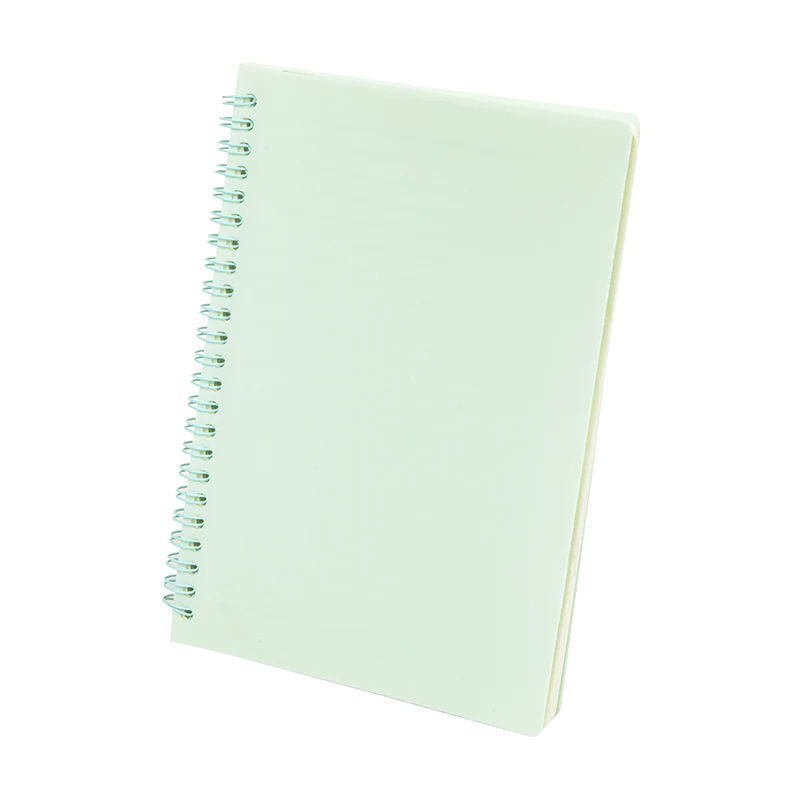
| Spiral binding | Excellent (360° rotation) | Moderate (coil can deform) | Field work, lab notes |
| Thread-sewn binding | Excellent (lies flat) | Excellent | Journaling, archival use |
For a professional who takes meeting notes, a case-bound Diary Notebooks with a ribbon marker is the best choice. It looks professional on a desk and protects the pages. For a student who needs to tear out pages, a spiral-bound notebook is more practical. For a writer who journals every day, a thread-sewn notebook is the best choice because it lies flat and the pages do not fall out. In our factory, we produce all four binding types. Wenzhou Yanhe Technology Co., Ltd. provides binding samples so that buyers can evaluate the quality before ordering.
3. What Size Suits Different Carrying and Writing Habits?
The size of the Diary Notebooks determines how portable it is and how much content it can hold. The most common sizes are A4, A5, B5, and A6. The A4 is suitable for desk use and detailed note-taking. The A5 is the most popular size for professionals because it fits in a briefcase or a large handbag. The B5 is slightly larger than A5 and is popular in Asia. The A6 is a pocket size for quick notes and reminders. The table below shows the recommended size for different applications.
| Size | Dimensions (mm) | Pages (typical) | Best application |
| A4 | 210 x 297 | 160 – 240 | Desk work, detailed notes, sketching |
| B5 | 176 x 250 | 160 – 240 | General note-taking, academic use |
| A5 | 148 x 210 | 120 – 200 | Professional use, meetings, travel |
| A6 | 105 x 148 | 80 – 120 | Pocket notes, reminders, gratitude journal |
Buyer's tip: When selecting a size for a corporate gift, consider the recipient's role. Executives prefer A5 because it fits in a laptop bag. Engineers and architects prefer A4 because they need space for sketches. Sales representatives prefer A6 because they can carry it in a jacket pocket. In our factory, we can produce custom sizes for specific applications. We also offer a range of cover materials, including PU leather, linen, and paperboard.
4. How Do Cover Material and Closure Affect Application Suitability?
The cover material and closure affect the durability and the user experience. A PU leather cover is durable and looks professional. A linen cover is more casual and is popular for journaling. A paperboard cover is lightweight and is used for disposable notebooks. The closure can be a magnetic flap, an elastic band, a ribbon tie, or a button. The table below shows the recommended cover and closure for different applications.
| Application | Recommended cover | Recommended closure |
| Corporate gift | PU leather | Magnetic flap |
| Personal journaling | Linen or fabric | Elastic band |
| Student notes | Paperboard | None (spiral binding) |
| Field work | Water-resistant PU | Elastic band or zipper |
| Travel diary | PU leather (flexible) | Elastic band |
In our factory, we produce Diary Notebooks with all of these cover and closure options. We also offer custom embossing, foil stamping, and screen printing for corporate branding. Wenzhou Yanhe Technology Co., Ltd. provides pre-production samples so that buyers can verify the appearance and function before committing to a production order.
Frequently Asked Questions About Diary Notebook Applications
Summary for Buyers and Product Managers
The application determines the ideal specification for a Diary Notebooks. For professional use, choose A5 with 80 to 100 gsm paper, a case binding, and a PU leather cover. For personal journaling, choose A5 or B5 with 100 to 120 gsm paper, a thread-sewn binding, and a linen cover. For student notes, choose A4 or B5 with 70 to 80 gsm paper, a spiral binding, and a paperboard cover. For pocket notes, choose A6 with 70 to 80 gsm paper and an elastic band closure. By matching the specification to the application, buyers can ensure that the notebook meets the user's needs and sells well. Wenzhou Yanhe Technology Co., Ltd. has been manufacturing diary notebooks for over 12 years and provides full customization and sampling services.
Wenzhou Yanhe Technology Co., Ltd. manufactures Diary Notebooks in A4, A5, B5, and A6 sizes, with paper weights from 70 to 120 gsm, and with case, perfect, spiral, and thread-sewn bindings. We provide cover material samples, paper samples, and pre-production proofs for all of our products.