

How Does a Straight Microduct Connector Improve Network Reliability?
2025-12-11
A Straight Microduct Connector is a precision-engineered component designed to join two microducts in a linear alignment, enabling secure, airtight, and low-friction pathways for micro-cable blowing operations. It functions as a critical link within fiber-to-the-premises (FTTP), fiber-to-the-home (FTTH), backbone microduct systems, and last-mile optical deployment architectures.
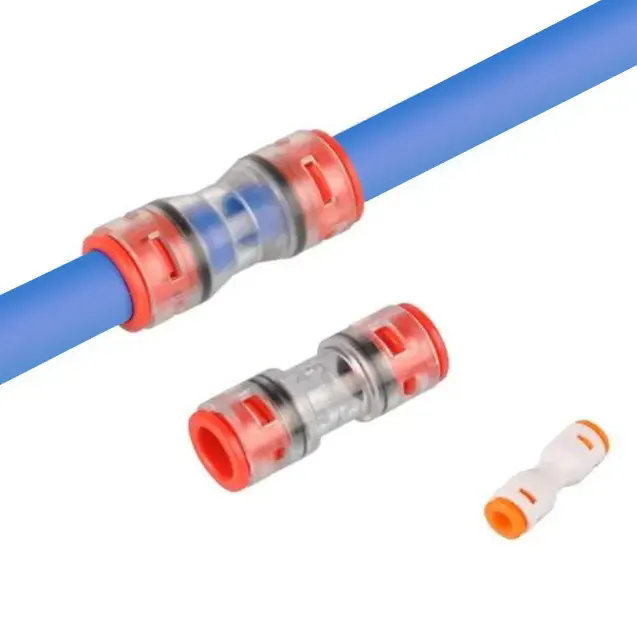
The central objective is to articulate how Straight Microduct Connectors support stable optical cabling installation, ensure micro-cable integrity during blowing processes, and contribute to scalable network architectures in urban, industrial, and rural broadband projects.
Technical Specifications of Straight Microduct Connectors
Below is a structured reference table summarizing typical technical parameters for professional deployment. Values represent industry-standard ranges widely adopted in modern microduct systems.
| Parameter Category | Typical Specification Range | Description |
|---|---|---|
| Supported Microduct Outer Diameters | 5–20 mm | Compatible with single-layer and multi-layer microduct pipes used in FTTH and long-distance networks. |
| Material Type | Polycarbonate (PC), PBT, or reinforced polymer | Ensures mechanical durability, UV resistance, and environmental stability. |
| Internal Sealing Mechanism | Double O-ring or multi-lip sealing | Provides airtight and watertight sealing under varied pressure loads. |
| Operating Pressure Rating | 10–25 bar | Sustains high-pressure air blowing for micro-cable installation. |
| Connection Type | Push-fit locking or threaded grip | Guarantees rapid installation without special tools. |
| Temperature Resistance | –20°C to +60°C | Suitable for both outdoor duct banks and indoor regulated environments. |
| Pull-Out Resistance | 120–300 N | Prevents microduct disconnection under installation tension. |
| Compliance | IEC, RoHS, or national telecom standards | Ensures safety, environmental compliance, and compatibility with global networks. |
These parameters position Straight Microduct Connectors as essential components for any microduct-based fiber deployment, ensuring structural reliability and optimal airflow performance during cable blowing operations.
Structural Role and Installation Principles of Straight Microduct Connectors
Straight Microduct Connectors serve as high-precision joints in distributed microduct networks, particularly where continuity of duct pathways is essential for efficient cable propulsion. Their design ensures that internal surfaces exhibit minimal turbulence, preventing airflow pressure loss during long-distance micro-cable installations.
The streamlined geometry inside the connector reduces frictional drag, enabling micro-cables to travel distance lengths exceeding hundreds of meters, depending on the compressor system and installation environment. This aerodynamic optimization is essential for project managers and telecom installers who require consistent outcomes across varied duct layouts.
Externally, the housing materials resist compressive force from soil, concrete encasement, thermal expansion, or conduit bundle vibration. The locking structure—whether push-fit or threaded—secures microduct ends by establishing uniform clamping force that eliminates micromovement. This stability protects fiber cable jackets from deformation or stress concentrations that could lead to signal attenuation.
Additionally, the sealing system prevents water ingress, dust contamination, and air leakage, each of which can impair blowing efficiency or long-term system reliability. In aquatic or moisture-prone environments, multi-lip seals maintain low permeability rates, ensuring that internal humidity does not compromise micro-cable performance.
In complex network extensions, Straight Microduct Connectors support phased rollouts by allowing installers to join future microduct sections into existing pathways. This modularity enables network providers to expand capacity without major construction efforts.
Operational Environments and Performance Dynamics
Straight Microduct Connectors are used across diverse infrastructures, including municipal broadband corridors, 5G small-cell backhaul routes, smart-factory industrial parks, and remote rural fiber access trails. Their operational performance is influenced by environmental conditions, microduct material compatibility, and airflow requirements.
In urban networks, they must tolerate high external temperatures from asphalt or underground power conduits. Their polymer composition ensures dimensional stability in heat-exposed conditions. In cold-region deployments, elasticity must remain sufficient to maintain airtight seals without embrittlement.
From a mechanical standpoint, pressure endurance is vital during micro-cable air blowing. Installers often apply 10–15 bar continuously, with higher spikes in certain directional changes. Connectors built with reinforced polymer bodies maintain structural integrity under these variable loads without warping.
Furthermore, optical cable installation crews rely on these connectors to minimize airflow loss at joint locations, which otherwise could cause stalling or inconsistent cable speed. Low-turbulence internal channels maintain laminar airflow through the microduct system, enabling predictable cable propagation across discontinuities.
In terms of longevity, premium Straight Microduct Connectors are tested for UV exposure, pollutant resistance, and chemical stability. These attributes ensure decades of field service, even under industrial pollutant exposure, agricultural chemicals, or urban particulates.
In telecommunication backbones where redundancy and resilience are mission-critical, the connector plays a key role in safeguarding microduct continuity. An improperly sealed joint can lead to moisture accumulation, internal duct corrosion, or long-term micro-cable degradation. Thus, specialized sealing performance is foundational for high-reliability networks.
Strategic Importance for Network Scalability and Future-Proof Fiber Deployment
As the scale of fiber deployment intensifies to support next-generation bandwidth requirements, Straight Microduct Connectors have become essential in enabling flexible network design. Microduct infrastructures rely heavily on modular topology, allowing operators to add new fiber cores or micro-cables as service demands increase.
The connector’s mechanical and sealing properties directly contribute to this scalability. By maintaining stable duct continuity, they support multi-channel expansion without excavating or replacing existing conduits. This feature is particularly critical for:
• 5G densification projects requiring fiber extensions to numerous small cells
• Smart-city IoT sensor interconnect pathways
• Cloud-edge computing nodes needing dedicated fiber backhaul
• New residential and commercial developments requiring on-demand FTTH service activation
Additionally, as micro-cables evolve to become thinner, lighter, and capable of higher data densities, the precision tolerances of Straight Microduct Connectors ensure compatibility with these emerging fiber formats. Their geometric uniformity helps to maintain consistent airflow during the blowing of next-generation ultralight cables.
On the sustainability front, microduct systems reduce material consumption by enabling incremental expansion rather than full-scale duct replacement. Straight Microduct Connectors reinforce this eco-efficient approach by allowing quick reconfiguration, limited excavation, and reduced energy consumption in installation operations.
The long-term trend suggests that network operators will increasingly rely on compact, multi-layer microduct networks incorporating dozens of pathways within a single corridor. In such dense deployments, Straight Microduct Connectors function as precision alignment devices critical to preventing air pressure discrepancies that could compromise overall network functionality.
Common Questions About Straight Microduct Connectors
Below are two frequently asked questions that arise during network planning, installation, and maintenance:
Q1: What factors determine compatibility between a Straight Microduct Connector and specific microduct types?
A1: Compatibility is primarily determined by microduct outer diameter, material composition, and wall thickness. Installers must ensure that the connector’s internal locking mechanism matches the duct’s structural rigidity to achieve a uniform seal. Pressure ratings must also align with the blowing equipment being used. Using an undersized or oversized connector increases the risk of leakage, air loss, or improper cable propulsion.
Q2: How can Straight Microduct Connectors maintain airtight performance during high-pressure cable blowing operations?
A2: Airtight performance is achieved through precision-molded housings combined with multi-lip or O-ring sealing elements. These components create a controlled compression zone around the microduct, preventing air escape even under fluctuations in blowing pressure. The internal bore is engineered to minimize turbulence, maintaining airflow velocity. Installers must ensure microduct ends are cut cleanly and inserted fully to avoid compromising the seal.
Straight Microduct Connectors will continue to play a decisive role in the construction of scalable, high-efficiency fiber infrastructures worldwide. Their mechanical strength, sealing performance, and compatibility with advanced micro-cable technologies make them indispensable for modern telecom deployments. Whether used in metro fiber rings, long-distance backbones, or last-mile access environments, these connectors support reliable network continuity and enable flexible expansion strategies.
Manufacturers such as Wenzhou Hantang Telecommunications Technology Co., Ltd supply engineered Straight Microduct Connectors tailored for evolving fiber-optic standards, ensuring robust performance across diverse installation environments. Organizations seeking dependable microduct connectivity solutions are encouraged to contact us for comprehensive technical guidance and product support.