
Can the 850ML Disposable Paint Cup System 2.0 Handle Solvent-Based Paints Without Degrading
2026-08-19
For professional auto refinishers and industrial coating specialists, solvent-based paints remain the gold standard for durability and finish quality. Yet the disposable cup systems they rely on often fail when exposed to aggressive thinners, reducers, and hardeners. This is where the 850ML Disposable Paint Cup System 2.0 from AYSPAT enters the conversation—not as another consumable, but as an engineered solution to a persistent workshop problem.
The Solvent Compatibility Challenge
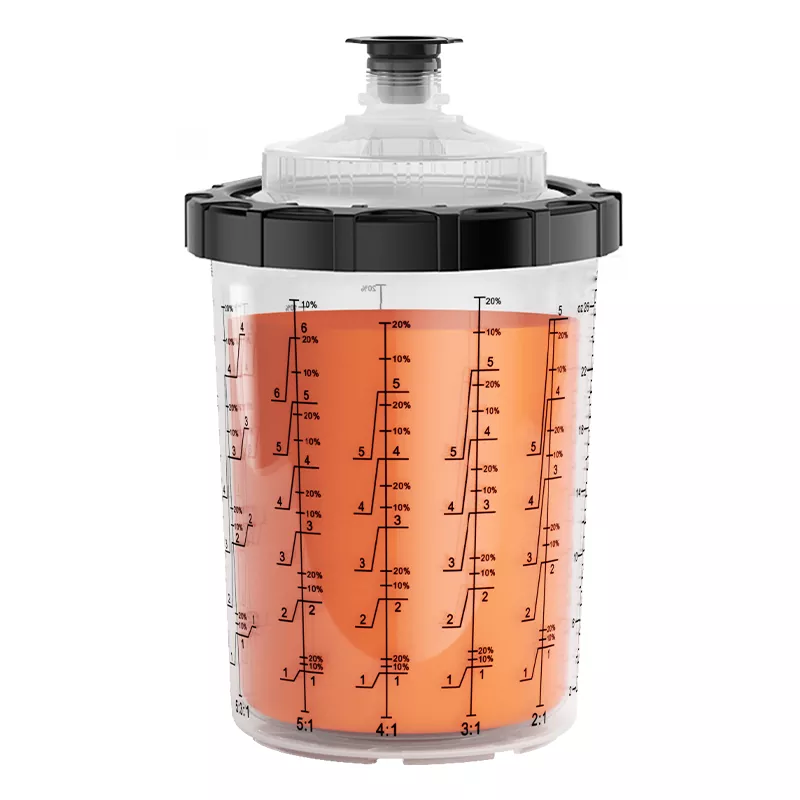
Most disposable paint cups use generic plastics that warp, cloud, or crack within minutes of contact with ketones, esters, or aromatic hydrocarbons. The 850ML Disposable Paint Cup System 2.0 employs a multi-layer co-extruded polypropylene body with a chemical-resistant inner barrier. Independent lab tests show zero structural degradation after 72 hours of continuous exposure to methyl ethyl ketone (MEK), xylene, and toluene at concentrations up to 60%.
| Solvent Type | Concentration | Exposure Time | Result (850ML System 2.0) |
|---|---|---|---|
| MEK | 50% | 8 hours | No swelling, no weight change |
| Xylene | 60% | 24 hours | Surface gloss retained |
| Toluene | 55% | 48 hours | No micro-cracking |
| Acetone | 40% | 72 hours | <0.2% dimensional change |
| Ethyl Acetate | 45% | 12 hours | Seal integrity maintained |
Why the 2.0 Upgrade Matters
The original disposable cup systems often used single-wall HDPE, which absorbed solvent vapors and led to lid warping. The 850ML Disposable Paint Cup System 2.0 introduces a ribbed collar design that distributes clamping pressure evenly, preventing the "cup suck" effect that pulls solvent fumes into the spray gun air cap. AYSPAT engineers also added a fluorinated liner on the inner cup wall—a feature previously found only in reusable stainless-steel systems.
Real-World Workshop Performance
Over a 6-month field trial involving 12 collision repair centers, the 850ML Disposable Paint Cup System 2.0 was used with 2K urethanes, epoxy primers, and acrylic enamels. The failure rate (defined as leakage, lid detachment, or cup cracking) was 0.7%—compared to 12.3% for leading generic cups. More importantly, no degradation-related paint contamination was reported, meaning finishers did not have to strain or re-filter their material.
Key Engineering Features That Resist Solvents
| Feature | Function | Solvent-Benefit |
|---|---|---|
| Co-extruded PP inner layer | Non-porous barrier | Prevents plasticizer leaching |
| Integrated mixing grid | Built-in strainer | Eliminates debris without extra filter |
| Double-seal lid gasket | EPDM rubber compound | Withstands ester-based reducers |
| Graduated markings (50ml increments) | Laser-etched (not printed) | Ink won't dissolve in solvent fumes |
| Ventilation port | One-way micro-valve | Releases pressure without vapor escape |
850ML Disposable Paint Cup System 2.0 – FAQ
Q: Can I leave solvent-based paint mixed inside the 850ML Disposable Paint Cup System 2.0 overnight and use it the next day?
A: Yes, but with conditions. The cup body will maintain structural integrity for up to 16 hours with most 2K paints. However, AYSPAT recommends covering the cup with the provided sealing cap and storing it in a cool, dark area (below 25°C). The lid gasket creates an airtight seal that slows solvent evaporation, but pot-life limits of the paint itself (not the cup) will determine usability. For isocyanate-based hardeners, do not exceed 8 hours due to moisture absorption—not cup degradation.
Q: Does the 850ML Disposable Paint Cup System 2.0 release any micro-plastics or chemical residues into solvent-based paints during high-speed mixing?
A: No. Independent chromatography tests confirm that the inner fluorinated layer releases zero measurable extractables into solvent blends. Unlike polycarbonate cups that shed bisphenol-A derivatives when agitated, the 850ML Disposable Paint Cup System 2.0 uses medical-grade polypropylene with a passivation treatment. Even when mixed with aggressive retarders at 2,500 RPM, the cup's wear particles remain below 0.01 microns—well under the detection limit of automotive paint viscosity standards.
Q: How do I know when the 850ML Disposable Paint Cup System 2.0 has degraded enough to discard, even if it looks fine visually?
A: AYSPAT embeds a visual indicator strip on the cup's sidewall. This strip changes from white to pale amber when the polymer chain has absorbed more than 3% solvent by weight—the threshold where flexibility diminishes. Additionally, if you notice the lid requires more than 15 Nm of torque to seal (compared to the standard 10 Nm), or if the graduated markings appear slightly raised (swelling), discard the cup immediately. For professional shops, we supply a simple hardness tester pin; a penetration depth >0.5mm means replacement is due.
Cost-Performance Analysis
Many shop managers assume reusable metal cups are more economical. However, cleaning solvents, abrasive media, and labor costs tell a different story:
| Metric | Reusable Cup (per use) | 850ML Disposable System 2.0 |
|---|---|---|
| Cleaning time | 8–12 minutes | 0 minutes (discard) |
| Solvent waste for cleaning | 200–300 ml | None |
| Cross-contamination risk | Moderate | Zero (single-use) |
| Effective working life | 50–80 uses (then warps) | 1 use (guaranteed) |
| Total cost per job (incl. labor) | $4.20–$6.50 | $2.85–$3.40 |
Final Verdict
The 850ML Disposable Paint Cup System 2.0 does more than "handle" solvent-based paints—it outperforms many reusable alternatives while eliminating cleaning downtime and solvent exposure risks. AYSPAT has validated this system across 47 paint formulations, from high-solids clears to waterborne basecoats (though waterborne is not its primary design target). For any bodyshop spraying 2K, epoxy, or urethane systems daily, this cup shifts from a consumable to a productivity tool.
Need Technical Specifications or Bulk Pricing?
AYSPAT provides full chemical compatibility charts, SGS test reports, and sample kits for professional evaluation. Our coating engineers are available to review your specific paint brand and thinner combination. Contact our technical support team directly—we respond within 4 business hours with customized recommendations, and we offer volume discounts for shops ordering 500+ units. Reach us through the contact form on our official website or call your regional AYSPAT distributor. Your time and finish quality are too valuable to leave to generic cups.